
Will AI hasten corporate decline?
We live in the age of the oligarchs, their trans-national corporate entities dictate government policy (around the globe), while extracting health from our earth and capital from exhausted working people and governments.
But maybe, the age of corporate power is starting to fade…
Finished laughing yet? Well, pick yourself up off the floor. Ok, here goes nothing.
AI adoption rates are highest on large corporates. It makes sense, they have the money to throw at AI experts or expensive solutions and the people to redirect to ambitious AI projects. Yet the latest stats show a large proportion of corporate employees report AI is making them less efficient and projects are dying on their proverbial arses.
I worked on corporate change programs for years and the only surprise, is that we are surprised.
Big corporates are slow moving, bureaucratic and change averse. The siloed and specialised nature of work lends itself to super smart subject matter experts, but any benefits are lost in handovers, misalignment, reporting and political shenanigans. Pet projects die alongside executive careers while the machine chugs along unfazed. Add that to legacy data / infrastructure and it becomes apparent why enterprises are seeing minimal benefit, you can’t polish a turd. So while AI will certainly reap some gains (and potentially transform courageous, agile companies), we should not expect miracles.
The elephant in the room for most corporates is their business model. If you exist to service shareholders, you are beholden to share prices, dividends, reporting cycles and market confidence. So even if a large company realises major productivity gains from AI, they don’t redirect people to transformative bets, they reduce headcount to sweeten shareholder dividends. nb. I really dislike the phrase ‘reducing headcount’. Let’s call it what it is, real people being cast aside to fend for themselves/families in a cost of living crisis, during a time of ecological and social collapse.
This not a reflection of the C suite per se, but a reflection of a corporate structure optimised for perverse incentives. Any caring CEO who places people or planet ahead of profit will quickly be replaced with someone more willing to do the dirty work.
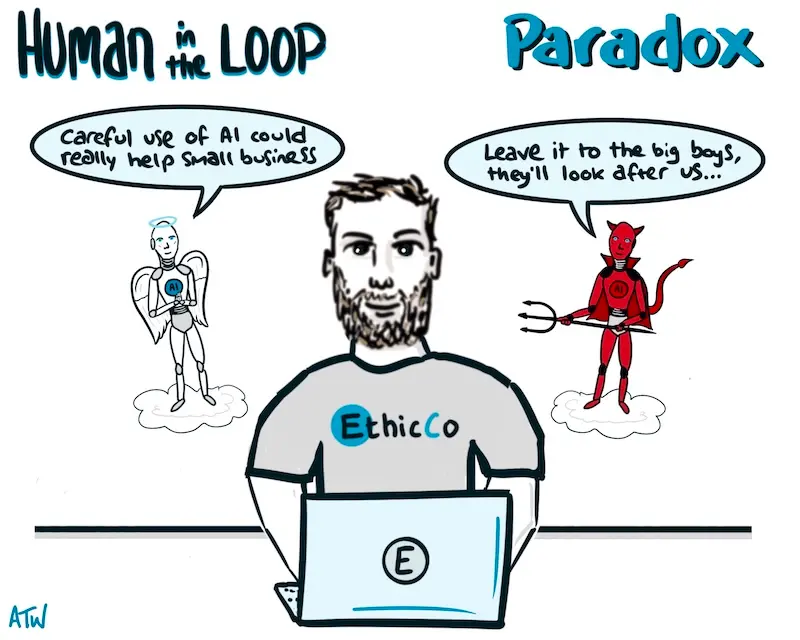
Let’s turn our gaze to small-medium enterprises (SMEs) – the backbone of the Australian economy. Adoption of our latest shiny trinket has been much slower. That makes sense, SMEs most likely don’t have the in-house AI technical expertise or the bandwidth to invest in lengthy exploration. They have much less capital to splash on AI guns (or snake-oil consultants who claim to be), they are rightly concerned about the risks associated with their security/reputation. They may have ethical concerns about the rise of tech bros, surveillance capitalism or the environmental/social concerns of runaway AI. Busy, bombarded with hype, paralysed by fear, it’s hard to know where to start.
That’s a real shame because my own recent experience suggests small businesses are the very folk who can genuinely benefit from this emergent technology. Small business life is much more generalist (as I have mulled previously), you can’t delegate everything (unless you have deep pockets) so you end up getting your hands dirty on things that are outside your wheel house. This is where considered use of AI can jump-start the learning curve and get you something imperfect but decent. It can’t replace the knowledge and experience of an expert, but sometimes acceptable is good enough – smash it out and get on with the next thing.
AI benefits are relatively greater for SMEs. eg. consider a few hours of productivity gains automating a clunky manual process. That’s a massive opportunity for a small company of 10, it’s an irrelevance for an organisation of 10,000.
So where does this leave us? Our world is being run (into the ground) by the oligarchs, protected by armies of corporate lawyers, lobbyists and complicit media. AI is the latest lever to squeeze out a little more from our world and all those in it.
But if we check in with our gut, we can feel it deep down (whether we admit it or not) – the system is dying. There will be no eternal growth on a finite planet, AI and an army of digital workers doesn’t change that (if anything, it speeds us towards the inevitable tipping point faster).
But maybe, AI is the crack in the carefully curated corporate paving, maybe it’s the gap through which the weeds appear. SMEs already make up the majority of the Australian workforce, AI will likely assist in their growth (at the expense of large enterprises). Fit and healthy small-medium businesses will be ready to shape a new economy as the false certainty of the corporate age crumbles.
And before you ask.. AI didn’t write this (or create the visual), a human sitting in a cramped office / linen cupboard did.
Stay human
Ewan
